ATLANTA, April 11, 2023 (Newswire.com)
-
Vizzia Technologies, a leading software and managed service provider of real-time location systems (RTLS) for healthcare organizations, recently received the 2023 North American Company of the Year Award in the RTLS industry by the influential research firm Frost & Sullivan.
Frost & Sullivan's prestigious Company of the Year Award is its top honor and recognizes the market participant that exemplifies visionary innovation, market-leading performance and unmatched customer care. The award highlights Vizzia's unique customer service, which the company has the highest customer retention rate in the industry.
"Vizzia enjoys strong brand equity as a leading provider of RTLS solutions to healthcare facilities and is the only company that offers an end-to-end value chain proposition in the RTLS industry," remarked Bhaskar Vittal, industry principal at Frost & Sullivan. "The company provides hardware, software, and support services, making it a one-stop-shop provider for hospitals' asset management needs."
Frost & Sullivan analysts independently evaluated Vizzia on the following criteria:
Visionary Innovation & Performance - addressing unmet needs, visionary scenarios through mega trends, leadership focus, best practices implementation and financial performance.
Customer Impact - price/performance value, customer purchase experience, customer ownership experience, customer service experience and brand equity.
In its evaluation, Frost & Sullivan noted Vizzia's focus on optimizing medical device asset management for acute care hospitals and its precise customer service methodology. Also mentioned were new RTLS projects for Children's Healthcare of Atlanta, Grady Health System and Piedmont Healthcare.
A complimentary copy of the Frost & Sullivan best practices report is available here.
"Vizzia is honored to be recognized by Frost & Sullivan for our industry best practices," said Jim Forbes, Chief Strategy Officer of Vizzia Technologies. "The value we deliver to our customers with innovative solutions and superior support has greatly contributed to this award."
Meet Vizzia executives and partners at the HIMSS23 global conference in Chicago (April 17-21). Please contact us to schedule a meeting: [email protected]
About Vizzia Technologies
Vizzia is a recognized leader in advanced real-time location systems (RTLS) and data analytics for healthcare organizations. Its award-winning InVIEW℠ software platform provides real-time, actionable data and process visibility to improve enterprise efficiencies and patient care. Founded in 2005, Vizzia serves several of the largest hospitals and health systems in America. For more information, please visit VizziaTech.com.
Naples, Florida proprietary trading firm SurgeTrader — a member of the Valo Holdings Group family of companies — sponsors the 2023 Fight for Air Climb Dallas benefitting the American Lung Association.
DALLAS, April 11, 2023 (Newswire.com)
-
Naples, Florida-based prop firm SurgeTrader has stepped forward as a key sponsor for the American Lung Association's annual Fight for Air Climb in Dallas, Texas on Saturday, April 29, 2023.
A member of the Valo Holdings Group family of companies, SurgeTrader provides financial support to traders across the world with real money accounts ranging up to $1 million, where funded traders keep up to 90% of the profits they earn. A cornerstone of the firm's mission is its commitment to philanthropy — helping charitable organizations across the communities they serve.
In addition to sponsorship, SurgeTrader will field a large team of climbers, made up of staff, friends and family. Valo Holdings Group CEO and SurgeTrader Founder Jana Seaman comments, "We're proud to support the American Lung Association in this incredible event, furthering their mission of saving lives through healthy lungs and healthy air."
The Fight for Air Climb is an annual event where climbers conquer a course of stadium stairs and raise money in support of the American Lung Association. A family-friendly event, the Fight for Air Climb is designed for every type of climber, from beginners to competitive climbers — even featuring a walking course. This year, the Fight for Air Climb Dallas will tackle the iconic Gerald Ford Stadium at Southern Methodist University, centrally located in the heart of Dallas, Texas. Over the last 12 years, the event and its climbers have raised more than $71 million to support the mission of the American Lung Association.
Remarking on the event and partnership with SurgeTrader, ALA Dallas Development Director, Dolores Johnson, says, "We are thankful for SurgeTrader's sponsorship of the 2023 Dallas Fight for Air Climb and their support of our mission of healthier lungs and healthier air because, when you can't breathe, nothing else matters!"
About the American Lung Association:
The American Lung Association is the leading organization working to save lives by improving lung health and preventing lung disease through education, advocacy and research. The American Lung Association is focused on four strategic imperatives: to defeat lung cancer; to champion clean air; to improve the quality of life for those with lung disease and their families; and to create a tobacco-free future. For more, visit Lung.org.
About SurgeTrader:
SurgeTrader, LLC is a US-based proprietary trading — or prop trading — firm, with a mission to accelerate trader funding and provide capital to profitable traders. Once traders have proven they can be profitable by passing an Audition, they become a part of the SurgeTrader-funded trader community, with access to an account funded with up to $10 million in buying power. For more information on SurgeTrader or how to become a funded trader, visit https://www.surgetrader.com.
Contact Information:
Chrissa Alghini
Marketing Director [email protected]
239-944-5317
NEW YORK, April 11, 2023 (Newswire.com)
-
Recora today announced its partnership with Cardiovascular Institute of Scottsdale to offer virtual cardiac rehabilitation for heart disease patients. The program adds to the robust suite of services CVI Scottsdale provides to heart disease patients, creating a new, innovative way to expand access for patients and allow them to recover from home in a virtual environment.
"As our practice continues to evolve and identify ways to better serve our patients, it seemed a natural fit to introduce Recora's Virtual Recovery Program to our market," said Dr. Nassim Haddad, Cardiologist, CVI Scottsdale. "Home-based cardiac rehab is proven to increase participation and improve outcomes, and we are excited about the possibilities this program can deliver to help our patients better their lives."
Recora will provide virtual tools for CVI Scottsdale's patients that can be accessed from the comfort of their own home, removing issues patients face with transportation and scheduling that prevent them from being able to access center-based care, along with on-demand support from care teams, 24/7 chat, and additional resources available throughout the program.
"Recora is fortunate to work with many leading health systems and practices throughout the United States, and our partners at CVI Scottsdale are as dedicated as any to their patient's cardiovascular health and care," said Recora CEO Abhishek Chandra. "Expanding our program to the Arizona community is an intriguing challenge for our team, and we look forward to the opportunities this will bring to heart disease patients in search of the right rehab program to meet their needs."
15% hospital readmission rate for Recora patients, versus the national average of 43% across Medicare patients with heart failure at six months.
87% Recora cardiac recovery program completion rate, versus the national average of 26%.
80% of patients with hypertension markedly improved their blood pressure due to diet and exercise
94% of Recora patients adhere to their cardiac medication.
80% improvement of distance and strength gains among Recora patients.
ABOUT RECORA
Recora's mission is to redefine the future of heart health. Recora's Cardiac Recovery Program for health systems, medical groups and health plans makes it easier to recover from a cardiac event through immersive programs delivered online. With Recora, healthcare providers are able to establish a longitudinal relationship with patients and help them live longer, fuller lives. To learn more, visit recora.com.
ABOUT CARDIOVASCULAR INSTITUTE OF SCOTTSDALE
Cardiovascular Institute of Scottsdale (CVIS) was created in 2012 as a team of experts dedicated to the treatment and prevention of heart disease and vascular conditions using the most up-to-date, modern, and evidence-based treatments and medications. The care team provides a personalized and comprehensive treatment plan that incorporates an emphasis on diet, exercise, and overall healthy habits. The goal is to optimize the cardiac risk to prevent future cardiovascular events. When patients present with problems that may be cardiovascular in nature, we determine the most likely diagnosis and formulate a treatment plan and follow-up strategy that is tailored for every patient based on their profile and risk factors.
Contact Information:
Adam Hritzak
Director of Marketing, Recora [email protected]
614-946-7916
NEW YORK, April 11, 2023 (Newswire.com)
-
Just as there are two sides of a coin, there are also two schools of thought whether men and women can have purely "platonic" relationships. In Episode 2 of the Two Men Talking Podcast, Fred believes that a platonic relationship eventually leads to romance. Stanley, age 89, is convinced that platonic relationships are absolutely possible even after a smooch.
To hear the differing views of these Ladies' Men "gents" with more than 160 years of combined life experiences, listen to Episode 2 of their April 11th Podcast. The topic: "Love or Lust: Can Men and Women Have Purely Platonic Relationships?", can be listened to at www.TwoMenTalking.com. The episode is part of a series of refreshing and thought-provoking listens for men, women, and anyone "in-between" from ages 20 to 100; anyone who loves living life to the fullest.
About Two Men Talking Podcast
With more than 160 years of combined life experiences, Stanley and Fred offer listeners a candid and relatable perspective on dating, relationships, women, and even life's impossibilities. To listen to the podcast and learn more about Stanley and Fred, visit their website at www.TwoMenTalking.com.
Contact Information:
Ann Marie Abraham [email protected]
212-956-1807
While John Cena appears in various movies and TV projects, the former wrestler pays tribute to where he came from with a new docuseries.
While Peacock has the library and original programming of the WWE Network, the famed wrestling brand continues to expand as Roku gets in on more of the streaming content game. According to The Hollywood Reporter, John Cena will be producing a new docuseries for Roku titled WWE: Recruits. The concept for the series is more of a serious take on the WWE reality show Tough Enough. Whereas Tough Enough is more of a competition between a group of people vying to become the newest talents in the WWE world, WWE: Recruits is more of a look at the journey of wrestling hopefuls as the company seeks to develop the new talent as future stars.
The WWE is currently making history by merging with another immensely popular combat entertainment company — the UFC. The Ultimate Fighting Championship brand has had great success in producing a similar series titled The Ultimate Fighter, which gives fans a look at the behind-the-scenes training of up-and-coming talents in the sport. This new series is one of the first examples of what both companies hope to accomplish with their collaboration. This deal with Roku adds to the bevy of networks that currently distribute WWE content, which also includes NBCUniversal, Fox, A+E Networks, and Netflix. Although, its actual matches and events are only on USA, Peacock, and Fox.
In addition to producing, Cena will be making an appearance on the show alongside Paul “Triple H” Levesque, who is currently in charge of WWE creative, Ric Flair, Shawn Michaels, and Bianca Belaire. Filming has gotten underway, with some content having already been produced at Wrestlemania last weekend. Cena gave a statement which outlined his intention of the show, “Millions around the world watch and dream of it, but only a handful of extraordinary individuals can become a WWE Superstar. I am so excited to bring WWE: Recuits to The Roku Channel and look forward to giving viewers an exclusive all-access perspective on how the WWE turns the dreams of talented young people into a reality.”
Sean Boyle, the head of adventure and exploration programming for the Roku Channel, would add, “Roku Original series WWE: Recruits not only unpacks how the WWE transforms unknown athletes into world-renowned stars, but also invites audiences into the lives of an unforgettable group of young people chasing their ultimate dream. We could not be more excited to work with the icon himself, John Cena, as our executive producer and our outstanding partners, the WWE and A. Smith & Co Productions, to share the untold story of this high-stakes world.”
Plot: Follows the aftermath of a road rage incident between two strangers. Danny Cho, a failing contractor with a chip on his shoulder, goes head-to-head with Amy Lau, a self-made entrepreneur with a picturesque life. The increasing stakes of their feud unravel their lives and relationships in this darkly comedic and deeply moving series.
Review: Beef is a series that seemed to come out of nowhere. The trailer, which debuted just a few weeks before this week’s series premiere, instantly buzzed around the internet. With a darkly comic sensibility, Beef appeared to be a hilariously twisted dive into the minds of two people who were contending with trauma, stress, and anxiety precipitated by a road rage incident. Having seen the entire ten-episode run of Beef, I can say that this series is much more than just a comedy. Thanks to stellar turns from stars Steven Yeun and Ali Wong, Beef is a look into the emotions and struggles everyone deals with daily but compressed into two similar yet completely different individuals living in Los Angeles. Beef kicks off immediately, never lets up, and will instantly become one of the year’s best series.
The trailers and the clip below center around the feud between Danny Cho (Steven Yeun) and Amy Lau (Ali Wong). When Amy blocks Danny from backing out of a parking space, their disagreement escalates into a road-rage chase that leaves both enraged. Danny, a struggling contractor living with his younger brother Paul (Young Mazino) and trying to make ends meet, wants to find the driver who flipped him off in the incident to avenge his lot in life. Amy, a successful business owner she is trying to sell, wants nothing more than to find happiness and balance in her life and takes out her frustrations as a boss, mother, and wife on the guy in the pickup truck. As each episode progresses, Danny and Amy vent their emotions from the almost accident while also discovering ways to face the things that truly make their lives miserable. It is a wonderful dichotomy to see these two people despise each other even though they have much in common.
As the tactics Danny and Amy use against one another spiral into more ridiculous extremes, the glimpse into their personal lives remains fascinating throughout the entire season. Danny wants badly to succeed and finds every imaginable obstacle in his way. Feeling out of control, Danny expresses his anger on his brother Paul while scheming with his recently paroled cousin Isaac (David Choe). While Danny tries complex ways to get back at Amy, he is deeply sad and struggling with his demons. Steven Yeun, who began his career pursuing stand-up comedy, has proven to be an incredible talent in everything from his breakout role as Glenn in The Walking Dead to his Oscar-nominated turn in Minari. Here, Yeun gets to exercise the comedic skills he honed early in his career and all of the dramatic weight this role demands. Yeun delivers a stunning performance here that runs the gamut of his range and is impossible to look away from.
Ali Wong, another comedic talent, has also stretched herself into a more dramatic arena beginning with 2022’s short-lived Paper Girls. Wong’s performance here blows away anything she has done on screen before as she balances Amy Lau’s personal and professional lives. On one hand, Amy is a successful career woman who wants badly to sell her business to investor Jordan Forster (Maria Bello) so that she can be a stay-at-home mother to June (Remy Holt), and reconnect with her artist husband, George (Joseph Lee). The road rage incident shows Amy that she may not be as happy as she tells herself, and her revenge tactics connect her more deeply than she was prepared for. Ali Wong gets to stretch her acting skills just as strongly as Steven Yeun and deliver some empowering and highly charged sex scenes. Wong gets to channel her comedy differently than we have ever seen, and it is stunning to watch.
Each hour-long episode balances Danny and Amy’s arcs and how they interconnect with one another, the stakes escalating with every subsequent chapter. Series creator Lee Sung Jin has a background predominantly in comedy, having written for It’s Always Sunny in Philadelphia, Outsourced, Silicon Valley, Dave, and the animated Tuca & Bertie. All of those series give him and his writing staff an edge to their humor and the ability to blend the darkness of funny moments and the searing dramatic elements to them simultaneously. While Lee Sung Jin directs one episode, the remaining nine are spread between Hikari (Tokyo Vice), who directs three, and Jake Schreier (Brand New Cherry Flavor), who directs the other six. The stories carry the presence of Asian-American culture, including Chinese, Korean, and Japanese, but the series never feels like an “Asian” story. This is a quintessentially American story about haves and have-nots that also benefits from pulling from a multi-ethnic backdrop.
Beef occasionally feels mired in the repetitive formula of Danny and Amy feuding back and forth with each other. Still, I cannot find anywhere this story could have been truncated. The ten episodes encompass a huge amount of character development for each protagonist individually and with each other before coming to a head in the final chapters. I can think of a few series that can compare with the amount of funny and tragedy in Beef while presenting two equally stellar performances from the lead actors. Steven Yeun and Ali Wong had already proven themselves talented, but Lee Sung Jin’s Beef elevates them to a new level. Beef is an incredibly engrossing series from the very first scene and is sure to have everyone talking when it premieres on Netflix. Beef is not the series I was expecting it to be based on the trailer, but it is so much better than I was hoping for.
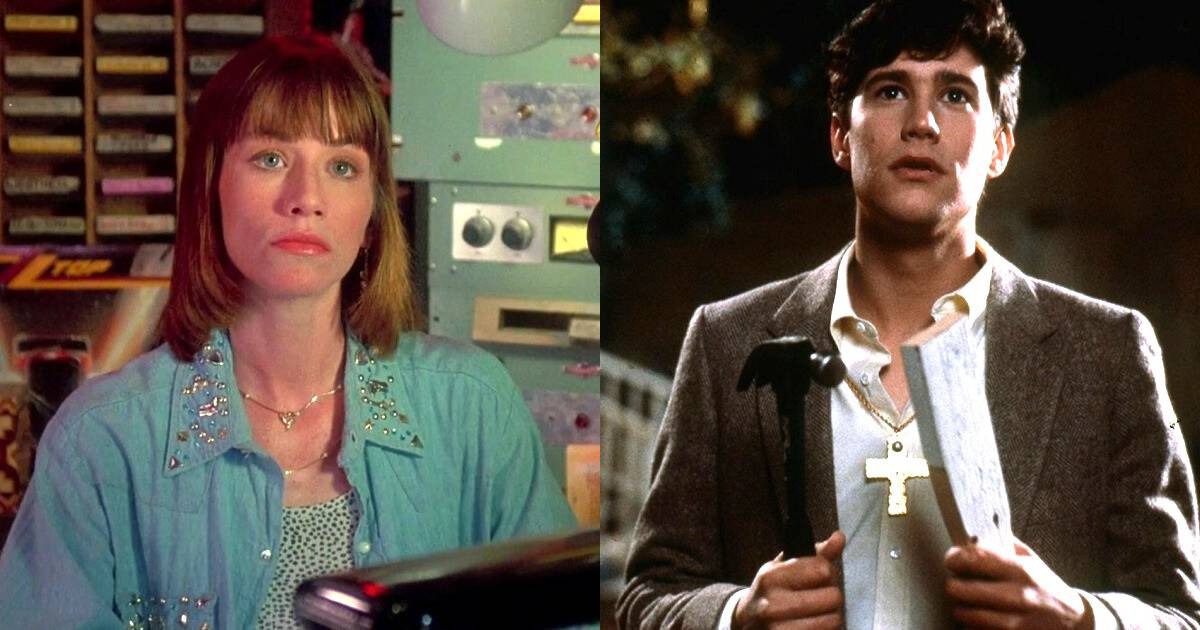
Texas Chainsaw Massacre 2’s Caroline Williams and Fright Night’s William Ragsdale are in the Dracula comedy Renfield
Universal’s Dracula comedy Renfield, starring Nicolas Cage as Dracula and Nicholas Hoult as his titular lackey, is set to reach theatres next week, on April 14th, and while the primary draw is the chance to see Cage play Dracula, the movie also includes a couple special treats for fans of the horror genre. Among the cast members are Caroline Williams, best known for playing the heroine Stretch in 1986’s The Texas Chainsaw Massacre 2, and William Ragsdale, who previously crossed paths with vampires in 1985’s Fright Night and the 1988 sequel Fright Night Part 2. Williams is playing a character named Vanessa, while Ragsdale takes on the role of Older Priest. Social media images of these ’80s horror icons in their Renfield roles can be seen at the bottom of this article.
Based on a treatment written by The Walking Dead creator Robert Kirkman, Renfield was directed by Chris McKay (The Tomorrow War) from a screenplay by Ryan Ridley (Rick and Morty). In Bram Stoker’s novel Dracula, R.M. Renfield was an inmate at a lunatic asylum who was thought to be suffering from delusions but actually is a servant of Dracula.
In this film, Renfield has been serving the bloodsucker for centuries, and now he has grown sick and tired of his centuries as Dracula’s lackey. The henchman finds a new lease on life life and maybe even redemption when he falls for feisty, perennially angry traffic cop Rebecca Quincy.
Cage, Hoult, Williams, and Ragsdale are joined in the cast by Awkwafina as traffic cop Rebecca Quincy, Adrian Martinez as her traffic cop partner Chris, Shohreh Aghdashloo as a feared crime lord named Ella, Bess Rous as “people in toxic relationships” support group member Caitlyn, and James Moses Black and Ben Schwartz in unspecified roles.
While Universal is developing several monster projects, they were excited to get Renfield into production first. According to Deadline, the story’s “mix of humor and action was something the studio was looking for because so many of the other properties have more of a horror element to them.”
Kirkman, who has described the film as “a violent comedy”, is producing Renfield with David Alpert, Bryan Furst, and Sean Furst of Skybound Entertainment, alongside McKay’s producing partner Samantha Nisenboim.
Renfield has been rated R for bloody violence, some gore, language throughout, and some drug use.
JoBlo / Arrow in the Head’s own Jessica Dwyer was able to visit the set of Renfield, and you can read her reports at the following links:
Will you be watching Renfield on the big screen later this month? What do you think of Caroline Williams and William Ragsdale being in the cast? Share your thoughts on this one by leaving a comment below. I was already looking forward to seeing the movie, but knowing that Williams and Ragsdale are in it makes me even more hyped to check it out.
Three years ago, SimplyRFiD and Frame Source Group set out to make the best inventory management system and transform the eyewear industry. Integrating 17 manufacturers into a seamless inventory ordering and management experience, 'AIMS' is now available and on-display at "The Exchange" -- the largest gathering of forward-thinking independent eye doctors in the world.
The AIMS system is powered by SimplyRFiD's Wave enterprise inventory system and optimized for eye doctors by the Frame Source Group. AIMS gives eye doctors the ability to compete with online and big-box retail by offering in-person try-ons, fast delivery, and a huge frame selection of 100,000 frames never before seen.
"Ever wonder why the frame you want or saw on a celebrity isn't there? Because 'best sellers' only last on the board for one day!" said Greg Smith, head of sales for Frame Source. "With AIMS, the best sellers go back on the board, and AIMS handles ordering a fresh frame directly from the manufacturer. With AIMS, the best frames are always in stock."
AIMS is directly integrated with 17 manufacturers sending stock levels and providing online ordering and drop shipping for optometrists.
These manufacturers represent the top brands with more than 100,000 frame choices. Sample brands include Ann Taylor, Burberry, Chanel, Dolce, Oakley, Persol, Ralph Lauren, Ray-Ban, Riserva, SuperFlex and hundreds more.
At the Show
A hands-on demo is available to experience how RFID reduces inventory time from one day to one minute. In attendance will be Carl Brown, President of SimplyRFiD, and Greg Smith, head of sales for Frame Source Group. A virtual demo from last year's Exchange is on TikTok.
About SimplyRFiD
SimplyRFiD revolutionized RFID adoption with the introduction of the DoD Pro-Tag in 2007. Today, SimplyRFiD leads the retail RFID inventory market with Wave for iOS, the #1 app for counting retail inventory with RFID. SimplyRFiD's three software platforms — AIMS for Eyewear, Wave for Retail, and Wave Audit for Manufacturing — provide tools for retailers to adopt accurate inventory systems. SimplyRFiD's latest product, AI Kick-Start, enables retailers to deploy the latest RFID technology and experience faster growth.
About Frame Source Group
FrameSource Group was founded in 2019 to revolutionize eyewear order processing and management.
SEATTLE, April 10, 2023 (Newswire.com)
-
FELCO, the world leader in pruning and horticultural tools, has recently launched a new range of gardening hand tools. This new gardening range is designed to help both landscapers and home gardeners to get the most out of their gardening experience. The gardening hand tool range includes a trowel, cultivator, weeder, fork, and Swiss Hori-Hori, all of which have been crafted with specific functions to help with gardening tasks.
The trowel is perfect at digging holes for seeds, plants, and flowers, while the cultivator is ideal for breaking up soil and preparing garden beds for planting. The weeder excels at removing weeds in vegetable gardens, fruit tree basins, and around vineyard plantings, while the fork can be used for aerating soil and turning compost. Finally, the Swiss Hori-Hori is an essential tool to dig up tap rooted weeds in lawns and gardens.
What's great about this new range of gardening hand tools is that they are made from high-quality, sustainable materials. Each tool is handmade to last and comes with a lifetime warranty, making them virtually unbreakable. The handles are made from sustainable FSC ash wood with an ergonomic contour, which is easy and comfortable to use over extended periods of time. The bright red handle color, synonymous with FELCO, is done by a phthalate-free, linen-based oil, ensuring the tools are easy to find in the garden.
Moreover, these tools are made from forged boron steel and hardened steel, which makes them heavy-duty, honed, and sharpened to perfection. Even the toughest gardening tasks are made easy. FELCO's commitment to excellence in quality and innovation is evident in this new product category, which will surely delight their demanding consumers.
As a professional landscaper or a home gardener, these new FELCO gardening tools will give the performance everyone is looking for. So, why not invest in a set of FELCO gardening tools for the next gardening project?
About FELCO
FELCO is a leading manufacturer of high-quality pruning tools and accessories. With a commitment to precision engineering and a focus on user experience, FELCO is dedicated to providing customers with the best possible products to help them get the job done right. All FELCO products are backed by a comprehensive warranty to ensure your complete satisfaction. Visit felco.com for more information.
The episode of WTF Happened to This Movie? covering Videodrome was Written by Jake Dee, Narrated by Matthew Plale, Edited by Diane Baldwin, Produced by Chris Bumbray and Ben Cantler, and Executive Produced by Berge Garabedian.
Have you ever considered how a movie becomes a bona fide cult classic? While many factors play a role, the phenomenon usually begins with a high-quality product that fails to resonate among the masses during its initial release due to ungraspable material ahead of its time, yet through its own undeniable merits, finds its passionate fanbase that grows over time and allows the film to become far more popular after the fact than it was in the present tense. In the case of David Cronenberg’s sci-fi body horror opus Videodrome, the film has overcome its notorious box-office failure to ascend as one of the most revered movies of Cronenberg’s illustrious career.
As Videodrome approaches its 40th birthday in February 2023, it’s worth breaking down what inspired the film, how it was made, and what production problems forced Cronenberg to alter his creative process, including the inventive ingenuity of the low-tech, DIY practical and video FX work and stunning make-up by the legendary Rick Baker, and ultimately, what doomed the film’s initial theatrical run and what led to its subsequent cult following over the next four decades. Sound good? Strap the f*ck in, and Long Live the New Flesh…it’s time to figure out WTF Happened to Videodrome ahead!
According to Cronenberg in the Criterion DVD audio commentary, the filmmaker drew inspiration for Videodrome from his childhood in Toronto, Canada, where he would illegally intercept American TV signals from Buffalo, New York, while staying up late at night after his local Canadian stations ended their broadcast. Cronenberg was terrified of witnessing content on pirated American channels he was not meant to see, including disturbing imagery that was not geared for mainstream public consumption. This spark of an idea ignited Cronenberg’s torrid imagination, telling Tim Lucas in Cinefantastique:
“I’ve always been interested in dark things and other people’s fascinations with dark things. Plus, the idea of people locking themselves in a room and turning a key on a television set so that they can watch something extremely dark, and by doing that, allowing themselves to explore their fascinations.”
Cronenberg also adapted the provocative themes of hyper-violence blended with lurid sexuality from his treatment for Network of Blood in the 1970s, a movie idea that also featured a protagonist that worked for a low-budget independent TV company that would ultimately evolve into the character of Max Renn in Videodrome. According to Cronenberg per Cinefantastique, the initial idea for the underground TV station was to explore “A private television network subscribed to by strange, wealthy people who were willing to pay to see bizarre things.”
Once the premise was locked, the plan was to tell the story from the protagonist’s first-person perspective, highlighting the dichotomy between how insane the character looks in the eyes of the public and how he himself perceives the altered states of reality happening inside his own mind. Cronenberg also incorporated elements from Network of Blood in the 1977 TV episode of the Canadian TV program Peep Show, entitled “The Victim,” giving the filmmaker an architectural blueprint that proved invaluable when it came time to write the screenplay for Videodrome. In a sly bit of social commentary, Cronenberg named the CIVIC TV station in the film after the real-life Canadian station CityTV, which was known for airing lurid pornographic material and ultra-violent movies during midnight broadcasts. During the film, one of Renn’s partners is named Moses, which is a bald reference to CityTV’s founder, Moses Znaimer.
Thanks to the financial success of his film Scanners in 1981, Cronenberg was able to secure funding for Videodrome much easier than he did earlier in his career on Shivers and Rabid. According to Cinefantastique, the success of Scanners allowed Cronenberg to obtain a production budget of $5.5 million from the Canadian Film Board and draw interest from various producers, studios, and above and below-the-line talent. Believe it or not, Cronenberg turned down the chance to helm Return of the Jedi to make Videodrome instead, citing his lack of interest in directing material produced by other filmmakers as the chief reason why (per Entertainment Weekly). While Cronenberg would have been an odd choice to oversee a Star Wars movie in the first place, his steadfast willingness to stick to his own creative sensibility only makes the filmmaker more respectable.
After declining to direct Return of the Jedi, Cronenberg reunited with producer Pierre David after collaborating on TheBrood and Scanners and pitched him two different ideas, one of which was Videodrome (per Cronenberg on Cronenberg).
The first draft of Videodrome was penned in January 1981. As often the case with Cronenberg’s writing process, the initial draft featured wildly outlandish sequences that had to be excised in order to make the material more palatable for wide audiences. In the scripting phase, Cronenberg eventually axed a physiological element of Max Renn that would have featured an explosive grenade in place of his chopped-off flesh gun during a hallucination. The original draft of Videodrome also included Renn and Nicki melting into an object after sharing a kiss, which in turn melted a nearby witness. There were also five additional characters dying of cancer, like Barry Convex, who was modeled after American televangelist and convicted fraudster Jim Orson Bakker. Furthermore, the character of Professor Brian O’Blivion was based on famed scholar Marshall McLuhan, whom Cronenberg studied under at the University of Toronto. McLuhan coined the phrases “hot” and “cool” media in relation to the TV screen and its content, a thematic fulcrum for Cronenberg to spin his creative wheels around and sinisterly subvert in the film.
Another key scene that was omitted from the screenplay right before it was scheduled to be filmed included a hallucinatory reverie in which Renn’s TV rises out of a bathtub after displaying a harrowing image. The production went through painstaking efforts to achieve the sequence, including placing Woods in the bathtub and filling it up with clear non-conductive liquid. However, at $25 per quart, the process proved to be too expensive to employ. In the end, the SFX team waterproofed the interior of the TV monitor using layers of insulation, which worked like a charm after testing the method in a swimming pool. Despite the TV floating to the surface due to the large vacuum fixed inside the picture tube, the effect was nixed at the last moment.
Per Cronenberg on Cronenberg, the director was certain that his original draft would be roundly rebuked by the independent company Filmplan International due to the extreme violence and sleazy sexuality. Much to Cronenberg’s surprise, the script was approved despite Cronenberg’s longtime producer Claude Heroux joking that the film was destined to receive a triple-X rating.
With the script in shootable shape by the summer of 1981, casting on Videodrome began in earnest. Per Fantastique, producers suggested casting James Woods for the lead role of Max Renn, persistently following up on their failed attempt to cast the actor in a movie called Models a year prior. Because Woods was such a fan of Rabid and Scanners, he agreed to meet with Cronenberg in Beverly Hills to discuss the part. Per the DVD commentary, Cronenberg appreciated how articulate Woods’ line delivery was and according to Cinefantastique, Woods reciprocated the sentiment for Cronenberg’s strange style and for being a “good conversationalist” who exuded a lot of power.”
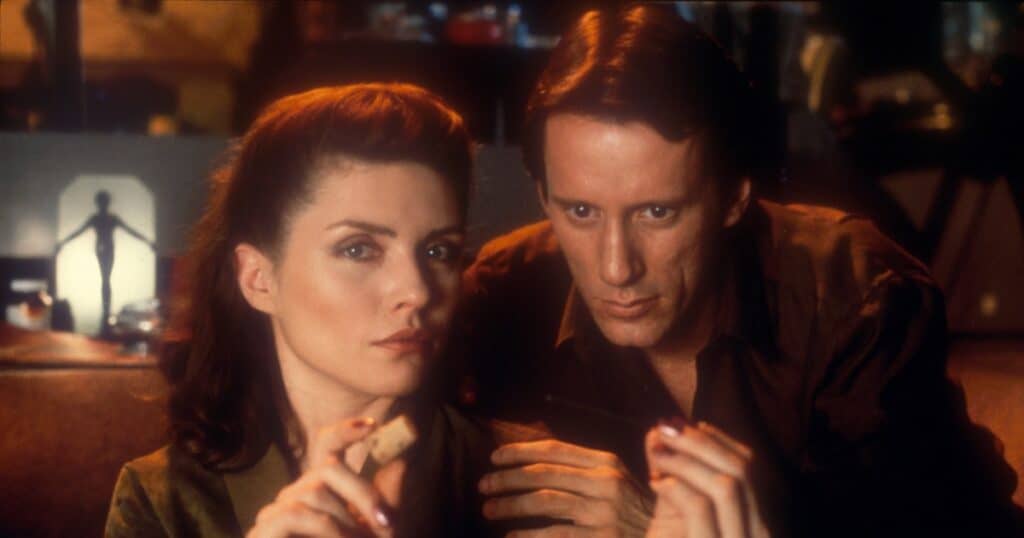
As for the casting of Debbie Harry, aka Blondie, for the role of Nicki Brand, it was producer Pierre David that suggested the pop-rocker for the role. Once Cronenberg studied Harry’s performance in the 1980 movie Union City in repeat viewings, he agreed to audition her for the part in Toronto. Harry credits Woods for assisting her with plenty of helpful tips while making the movie, something she relied on, having never played such a large speaking part in a movie before. Ironically enough, Blondie goes full redhead in the film, subverting her own pop image in lockstep with Cronenberg’s own sense of anti-mainstream rebellion.
Principal photography on Videodrome commenced in Toronto on October 19, 1981, and lasted until the early hours of December 24th. As a non-negotiable stipulation for being funded by the Canadian government, production had to be completed before the end of the calendar year and included a hard cut-off date, forcing Cronenberg to begin filming without a completed shooting script and with very little preparation time. While he did have the original script he thought would be rejected in tow, it served more as a guiding prototype while making the movie that would be pared down as time went on. While production had until December 31st to use the funds provided by the Canadian government, Cronenberg aimed to complete the film by Christmas Eve so that the cast and crew could enjoy the holidays with their families.
According to Criterion, the first week of the 2-month film shoot was dedicated to recording the video monitor insert shots of Brian O’Blivion’s bloviating TV monologues and the softcore pornographic simulations Samurai Dreams and Apollo & Dionysus. The camera used to film the video monitor sequences was a Hitachi SK-91 with Samurai Dreams filmed without any audio recorded at a Global TV studio rental space in Toronto. The sequence took half a day to complete and lasted 5 minutes longer than what appears in the final cut of the film (per Cinefantastique).
Despite disliking the flat, 2D TV format and feeling very uncomfortable filming violent sex scenes, cinematographer Mark Irwin stayed on board throughout the production. According to Cinefantastique, Irwin was much more comfortable filming with typical movie cameras than low fi videotapes and felt creatively hamstrung by the entire crew being able to see his lighting and camera setups on the monitors rather than having the privacy of blocking and arranging shots as he would on most movie sets.
One of the best decisions Cronenberg made during production was hiring Oscar-winning make-up FX legend Rick Baker to handle the film’s unique aesthetic. According to Screen Rant, Baker retained many of his twentysomething crewmates (whose average age was 23 years old) from American Werewolf in London, the first film in history to win an Academy Award for Best Special Make-Up, to work on Videodrome. As such, it’s time to dive into the nitty-gritty of how Baker, Cronenberg, and Special FX supervisor Michael Lennick achieved some of the sickest, surrealist, and most nightmarish moments that continue to withstand the test of time and haunt the memories of cinephiles everywhere.
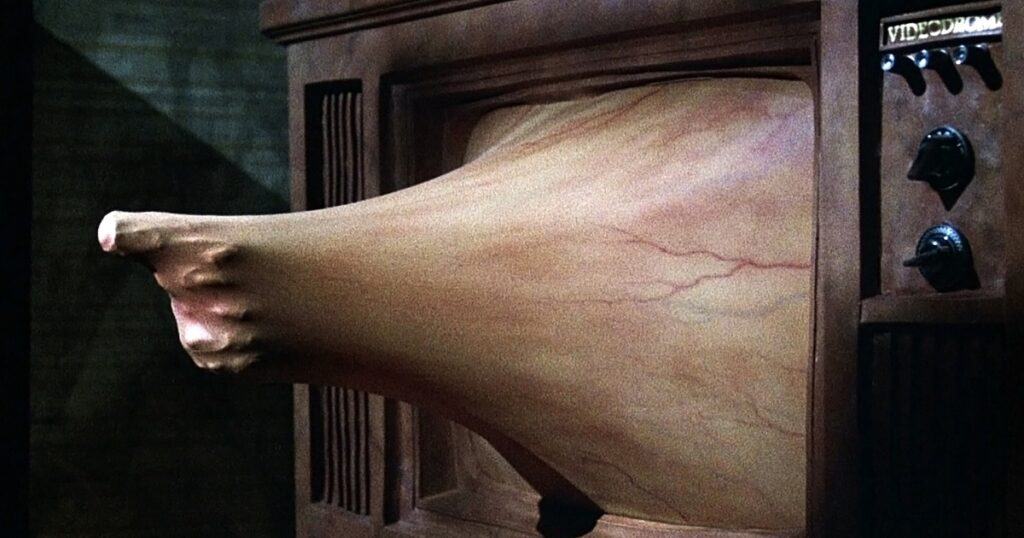
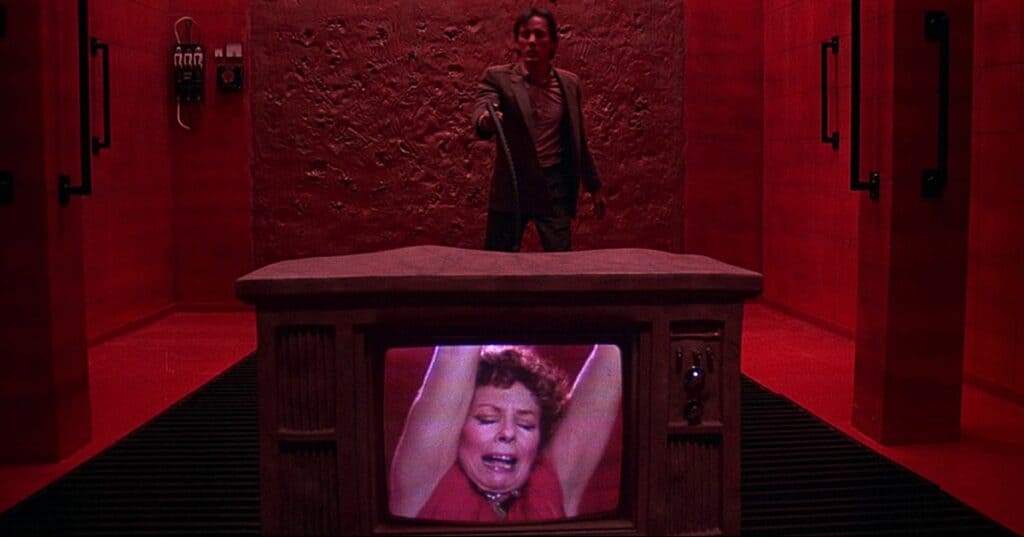
For the TV featured in the film, a real-life TeleRANGER model was used. According to Baker, the model was chosen because it was large enough to house the mechanical effects inside the physical apparatus. The SFX team built several models during production in order to test various FX methods, with Baker leading the experimental charge to push the envelope in ways for the technology to match the ambition of Cronenberg’s screenplay. According to Baker in a Criterion interview:
“I knew we would need a flexible material. And we tested it with a weather balloon first, stretching it over a flame the size of a TV screen and pushed a hand through it to see how far it stretched.”
According to Michael Lennick, it was a laborious effort to get the TV prop just right, telling Criterion that:
“We were originally going to do it as a blue screen effect. We were looking up various types of material… blue gelatin was one substance that we were working with, in which the actor could literally dunk his head into this stuff.”
Luckily, before submerging James Woods in a vat of Jell-O, a more artful solution was created. Harkening back to low-fi technology featured in King Kong, Baker and Lennick came up with a way of creating the heaving TV screen by using a projector and sheet of Dental Dam layered with extremely reflective white paint. Dental Dam was used in the early Hollywood days as a means of rear projection, which Baker noted: “was a nice sensual thing that James Woods could caress and it would respond.” Cronenberg agreed, adding in the DVD commentary that the result of the FX “had a tactility you don’t get with computer imagery.”
As for the freaky “breathing screen” FX in the film, Baker told Den of Geek in 2012 that it was achieved by first using a film camera to record a TV screen playing a performance of Debby Harry. The footage was then rear-projected through a large airtight plexiglass chamber onto an inflatable rubber sheet inside the television. This allowed the TV to contract and expand as needed for the scene, which required the collaborative efforts of the physical, makeup, and video FX teams. “I knew we would need a flexible material,” Baker told Cinefantastique, adding, “we tested with a weather balloon first, stretching it over a frame the size of a TV screen, and pushed a hand through it to see how far it stretched, and then we rear-projected on it.”
Baker expounded to Den of Geek in 2012, saying:
“I got the script and it had all this crazy ass stuff in it. I was like, ‘how the hell am I going to do this,’” adding that Videodrome was “one of the strangest assignments I’ve ever had” in the Criterion making-of documentary.
Indeed, Baker’s typical puppeteering methods included employing pullable wires, cables, and pressure controls. However, the TeleRANGER TV was too large to perform such a technique. Instead, physical effects supervisor Frank Carere came up with the idea to rig a keyboard organ with an air valve compressor pump, allowing the TV to balloon, restrict, and eerily undulate as needed throughout the sequence when Carere pressed certain keys. “It was something that evolved,” says Carere in the DVD commentary, adding, “I was trying to figure out how to control the maximum number of switches with my hands and then would I need two people, three people or four people or more. There was a lot of tweaking but Rick seemed very happy with the results so we went ahead and every night after shooting for a good week or 10 days, I stayed late just to work on the keyboard, and ultimately it gave us the control that we needed.”
Interestingly enough, according to Baker, Carere even found a proficient pianist to play Bach’s Toccata and Fugue in D Minor on the keyboard while operating the device to make it pulsate the way it does during the key scene in which Renn whips the TV set. That’s some serious f*ckin’ orchestration!
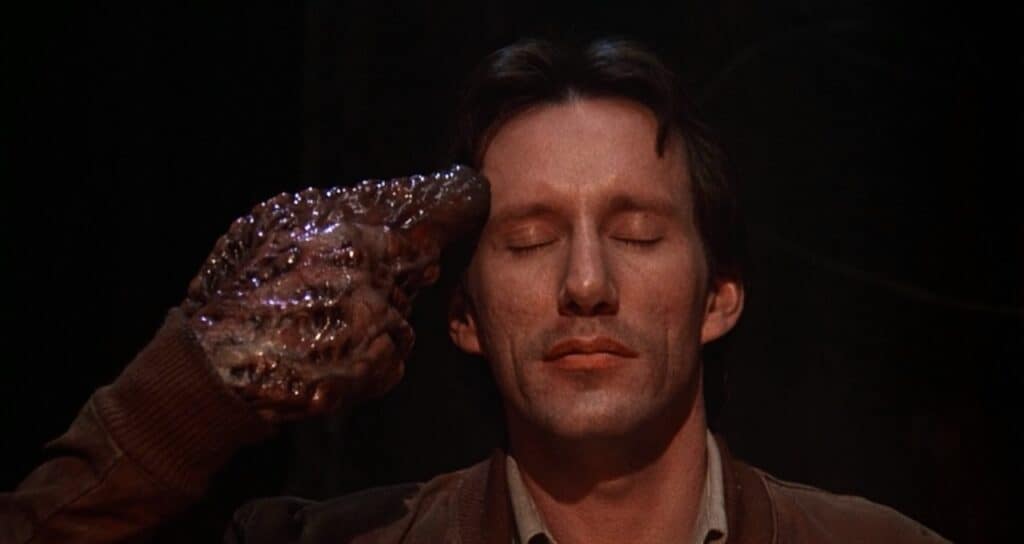
The videotapes inserted into Renn’s slit stomach cavity during the movie were actually Betamax cassettes, which were chosen because VHS cassettes were too large to fit properly inside the abdominal puncture. Woods found the stomach slit effect physically uncomfortable and began running out of patience with it, once lamenting that “I am not an actor anymore. I’m just the bearer of the slit” after a long day of filming while attached to the apparatus. The stomach slit sequence required Woods to be placed inside a couch built around him with the physical apparatus glued onto his chest. Woods was apparently so irate that he vowed never to have anything glued onto him for a movie ever again. As a playful form of payback, while filming the scene in which Renn shoots cold vaporous gas from his Flesh Gun, Woods painted his hand with blue paint prior to a take and briefly convinced Cronenberg that his hand was frostbitten.
When designing Renn’s iconic Flesh Gun, Baker originally conceived the prop to feature eyes, a mouth, and a foreskin, which Cronenberg found “too graphic” and discarded before it was created. In terms of the visual representations of cancer caused by Renn’s Flesh Gun, several tests were used to achieve the effect. Baker initially considered using solvents to distort the facial appearances but opted against the method upon realizing his longtime mentor Dick Smith used the same technique on Spasms in 1977 and didn’t want to appear like a phony copycat. In the end, it was Baker’s idea to show the cancer tumors erupting out of Barry’s body, which required the FX crew to operate a dummy of Barry’s body from beneath the set. According to Baker in the Criterion DVD commentary, “the effect where Barry Convex is coming apart, we had people under the set with their hands in these hot melt vinyl cancer puppets that had to come up and we had guys that were (operating) the arms of it and somebody else working some other part of the head. I remember after we shot the Barry Convex body all of us coming back to the hotel completely covered in this fake blood, this Caro sort of blood that is sticky as hell, and our shirts are stuck to us and we got in our hair, you know, it looked like we had been in some horrible accident.”
As for the distorted visual FX that occurs when Renn whips the TV set, Michael Lennick created a device he called the “Videodromer” to achieve such. Lennick also wanted to use Renn’s Videodrome helmet to create disorienting “glitch” and “twitch” FX that were ultimately scrapped before filming due to time and money concerns.
One thing casual and die-hard fans of the film may not know is that three different endings were filmed for Videodrome. The one used in the final cut was suggested by Woods, which ends with Renn shooting himself on the derelict ship. However, according to Cronenber via Criterion, an epilogue was originally planned but never filmed. The post-film sequence would have taken place after Renn’s suicide, in which he, Bianca, and Nicki appear on the Videodrome set, where the two women are shown to have bizarre biotech sex organs protruding from their own stomach slits that resemble Renn’s. According to Cronenberg:
“After the suicide, [Max] ends up on the ‘Videodrome‘ set with Nicki, hugging and kissing and neat stuff like that. A happy ending? Well, it’s my version of a happy ending—boy meets girl on the ‘Videodrome’ set, with the clay wall maybe covered in blood, but I’m not sure. Freudian rebirth imagery, pure and simple.”
Cronenberg attributed the dismissal of the epilogue to his own atheist beliefs in the DVD commentary, likening Renn’s resurrection to a connection to the afterlife, something the director does not believe in.
With the Christmas Eve production deadline fast approaching, Cronenberg and his FX team had one final shot to complete, which turned out to be such a disgusting moment on the set that many of those involved in the making of Videodrome remains haunted by. To achieve the shot of human brains jutting from the TV screen at the end of the film, real-life sheep guts were shot out of an air cannon. According to Carere, he went to an abattoir conveniently located across the street and requested sheep guts, fully expecting to be turned away. When he was told to return with green garbage bags 20 minutes later, the FX crew had the materials needed for the shot. However, it took at least a week from the time the sheep guts were acquired and when the effect was shot. By the time it came to filming, the overwhelming stench of rotten sheep guts was so strong it immediately cleared the room. “So at the last minute, we gloved up,” says Carere, adding “we put a breakaway glass screen in, we loaded the guts into the air cannon, and the rest is history.”
Unfortunately, the effect did not work as intended on the first take, requiring the entire crew to toil for an additional six hours one of the last days of a tiresome schedule to get it right. After Carere cranked the valves, the air cannon was wider, and the effect worked like a charm on the second take, which is what is seen in the film. The production finished the shot in the early hours of the Christmas Eve deadline.
Once principal photography concluded, Cronenberg reassembled his crew for a week of pick-up shots in the spring of 1982 to capture footage they were unable to during production and shoot new footage to accommodate what was cut in the editing room. “It was cut together in a manner that made it more than what we had shot,” claims Carere. According to Location Manager David Coatsworth, “the phrase the sum of the whole is greater than the sum of its individual parts… it’s a movie that has really stood the test of time. It’s a classic. Anybody who’s seen it remembers it.”
Cronenberg’s longtime musical collaborator Howard Shore created the trippy soundscape for the film, which was meant to aurally represent the hallucinatory headspace that Renn and the other’s experience, starting with classic orchestration that slowly devolves into electronic synth sounds. Shore achieved the feat by composing the entire soundtrack for an orchestra before recording it in a Synclavier II digital synthesizer. The synth recording was then played along with a small string section, creating a haunting, otherworldly effect (per Cinefantastique).
All of the combined organic, practical, physical, and DYI special FX is one the main reasons why Videodrome retains such an original aesthetic and no doubt one of the chief reasons why the film has attained all-time beloved cult status over the past 40 years.
Unfortunately, for all the excellent work that went into the making of Videodrome, the film took a financial drubbing at the box office when it was released in theaters on February 4, 1983. With a final production budget of $5.9 million, the film failed to earn even half of its money back, netting a total of $2.1 in international ticket sales. The film was declared a box office bomb but luckily enough for Cronenberg, his adaptation of Stephen King’s The Dead Zone released the same year became a big enough hit to allow the director to soar to new heights with his follow-up film, The Fly, which nearly tripled its budget at the box office and solidified Cronenberg as a bona fide filmmaker in the eyes of Hollywood.
Yet aside from the financial failure of Videodrome, the film drew endless praise from critics and filmgoers for its outlandish vision and original fusion of body horror and lofty science fiction tropes that would become synonymous with Cronenberg’s filmmaking style.
Interestingly enough, despite Videodrome not being released on VHS and DVD until the late 1990s, the film’s popular word of mouth became so strong that it won a slew of awards in 1984, including 8 Genie Award nominations and a win for Cronenberg’s Best Achievement in Directing, which he shared with Bob Clark for his stellar work in the classic holiday film A Christmas Story. Of course, Clark also helmed Black Christmas a decade prior, giving the two directors an inextricable horror link for their careers. The grand irony is that while A Christmas Story was a box office hit at the time and has since become an annual TV mainstay, Videodrome overcame its poor box office performance to become nearly as popular in horror/sci-fi circles. In 2010, Videodrome was listed by the Toronto International Film Festival as the 89th most-essential film in history, cementing the film as an all-time great despite its financial failings at the time of its release.
And that’s essentially What The F*ck Happened to Videodrome. The film entered production without a completed screenplay, took two months to film under a tightly mandated deadline by a Canadian government that funded the project, featured an incredibly inventive time for a young team of make-up, practical, and video effects collaborators working under the supervision of the great Rick Baker, leading to some of the inspired and innovative Special FX work in the 1980s that, despite its commercial hiccups at the time, has remained into the collective conscious of pop culture 40 years later as one of the most outlandishly original, sexily surreal, nastily nightmarish, deeply disturbing yet oddly arousing cinematic curios ever committed to celluloid. Sometimes a movie becomes a cult classic for all the wrong reasons. However, Videodrome proves that the merits of high-quality work will inevitably find its audience and become celebrated for what it continues to give to audiences generation after generation. Long Live The New Flesh, indeed!