Enhanced FDA reporting, full IQ/OQ package & incubator monitoring sensor round out Lab21 offerings
Environmental Monitoring for Laboratories Sonicu, which serves scores of public and private laboratories and research-intensive universities across North America, is improving its ability to serve their exacting Food and Drug Administration regulatory needs with its Lab21 offering.
GREENFIELD, Ind., May 16, 2023 (Newswire.com)
-
A national leader in temperature and environmental monitoring serving the research and laboratory industries is introducing an enhanced suite focused on better serving the life science professional focused on compliance automation and asset protection.
Sonicu, which serves scores of public and private laboratories and research-intensive universities across North America, is improving its ability to serve their exacting Food and Drug Administration regulatory needs with its Lab21 offering.
Lab21 represents a significant upgrade in delivering affordable and simple monitoring and compliance services, including:
Enhanced software features to comply with FDA 21 CFR Part 11 requirements
Group reports and the ability to have users all be able to comment/review/approve reports with cover sheets
Strict personnel controls and enhanced audit trails required by the FDA
Rapid alarm and notification testing with SoniCloud Validation Alarm feature for PQ compliance
A password allowing users to time-stamp who and when specific actions are executed
Double-verification, compliant with 21 CFR Part 11, for significant changes to the system settings
Full probe calibration history and regularly updated monitoring system health reports
Access restriction to unauthorized users, device check performance and support written procedures and system documentation which are all required for full compliance
White glove IQ/OQ offering to help customers streamline implementation
Joe Mundell, Chief Revenue Officer, Sonicu, said the new offering reflects significant growth in the life science industry around protecting their research and complying with increasingly strict regulatory requirements.
"Lab21 represents feedback from dozens of customers who request more sophisticated monitoring and regulatory reporting to support their research," Mundell said.
"We've worked closely with our customers to develop the features and functionality they need to work more efficiently and stay compliant."
When coupled with the Sonicu Incubator Monitoring sensor, which includes temperature, humidity and CO2, the new package is ideal for laboratory or life science applications.
The incubator monitor installs in minutes and configures simply into the SoniCloud software, providing real-time and historical visibility to help researchers validate their work and remain compliant with Food and Drug Administration guidelines.
When combined with our robust suite of temperature monitoring solutions, Sonicu offers labs and life science organizations the opportunity to consolidate their monitoring, protect their perishable assets and automate tedious regulatory reporting.
All Sonicu monitoring systems can be supported with our SNAP calibration program which automates the NIST calibration process, delivering another layer of compliance simplicity.
When coupled with the robust IQ/OQ service, Sonicu has the ability to help more labs with superior compliance readiness.
IQ and OQ protocols are methods for showing that the equipment being used or installed will deliver a high degree of assurance so production processes will consistently manufacture products that meet quality requirements.
Scores of laboratories and similar organizations, including the Ohio University Innovation Center, Xytex Sperm Bank and MiraVista Diagnostics, rely on Sonicu for their temperature and environmental monitoring.
Contact Information:
Bryan Mitchell
Vice President [email protected]
202-718-5155
Rumley Family Chiropractic is a prominent chiropractor in Winter Park, dedicated to transforming holistic wellness and restoring the body's natural balance and alignment. Led by Dr. Matthew Rumley and his team, they offer personalized treatment plans tailored to each patient's specific needs.
WINTER PARK, Fla., May 16, 2023 (Newswire.com)
-
Rumley Family Chiropractic, the premier Winter Park chiropractor, is proud to introduce their natural approach to holistic wellness and restoration of the body's natural balance and alignment. With a steadfast commitment to enhancing the overall well-being of their patients, Rumley Family Chiropractic is helping patients in Winter Park and beyond by integrating natural techniques and personalized treatment plans.
As the leading Winter Park chiropractor, Rumley Family Chiropractic employs various "tried and true" chiropractic techniques to address multiple health concerns, including spinal misalignments, degenerative disc disease, joint fibrosis, stiffness, whiplash, chronic pain, and much more.
Rumley Family Chiropractic is led by Dr. Matthew Rumley, along with his team of "therapists and assistants" who customize each treatment plan to meet the unique needs of every patient. Through meticulous assessments, comprehensive examinations, and advanced diagnostic tools, their team can gain valuable insights into the underlying causes of discomfort, enabling them to create targeted and effective interventions.
Recognizing the importance of a holistic approach to wellness, Rumley Family Chiropractic goes beyond chiropractic care. Complementing their services, they offer chiropractic adjustments, massage therapy, "Deep Tissue LASER," and spinal decompression, treating and teaching patients as a whole to help them to make informed decisions about their health and adopt long-term preventive measures.
Renowned for their patient-centered approach, Rumley Family Chiropractic has created a warm and welcoming environment in Winter Park. The compassionate staff is dedicated to ensuring the comfort and well-being of patients throughout their entire chiropractic journey.
"Everyone experiences illness and pain, but not everyone has the strength and bravery to seek answers to their health problems, face those problems, and fight to solve those problems," said Dr. Matthew Rumley, founder and lead chiropractor at Rumley Family Chiropractic. "It's not easy, but it's not supposed to be easy. You will need support during your journey of self-improvement, and my team and I will be with you shoulder to shoulder all the way."
Rumley Family Chiropractic invites individuals in Winter Park seeking a transformative chiropractic experience to visit their state-of-the-art facility and discover the benefits of their natural approach to holistic wellness. Check out their website for further information or to schedule an appointment.
About Rumley Family Chiropractic
Rumley Family Chiropractic is the leading Winter Park chiropractor, dedicated to delivering exceptional chiropractic care in a patient-centered environment. With their natural approach to holistic wellness, state-of-the-art techniques, and personalized treatment plans, they empower patients in Winter Park and beyond to achieve optimal health and well-being.
MIAMI, May 16, 2023 (Newswire.com)
-
Lingoda, the leading online language learning platform, has announced the launch of its Summer Sprint campaign, designed to help language learners achieve their goal of speaking a new language confidently over the summer months. The campaign will run from May 12-July 6 with two opportunities to sign up for the Sprint: the first Sprint opens May 12 with classes from June 12-August 10. The second Sprint opens June 9 with classes from July 10-September 7.
With the Summer Sprint campaign, Lingoda aims to encourage learners to dedicate themselves to their language learning goals during the summer, when they may have more free time and fewer distractions. With the Sprint being an intensive two-month language course unique to Lingoda, it is designed to achieve students' language learning goals faster and to build a consistent learning habit. Students will take 30 classes within two months when they enter the Lingoda Sprint - or even 60 language classes in 60 days when choosing the Super Sprint. The aim is to be able to speak a new language with confidence within two months while studying in small group classes of up to five people, following an expertly-designed curriculum.
For early Sprint sign-ups, Lingoda offers exclusive brand partnership offerings by GetYourGuide and Mubi that will support new students in their goal to make significant progress within two months. On top of the incentive package for early birds, the Sprint also offers the opportunity to earn between 50% and 100% cashback if students attend all the classes and follow all the Sprint rules. Qualifying students can also opt to request class credits at the end of the Sprint of higher value than the cashback would be.
"We know that the summer can be a challenging time for language learners, with vacations, outdoor activities, and other distractions competing for their attention," says Philippa Wentzel, Lingoda's Curriculum Team Lead. "That's why we're launching the Summer Sprint campaign—to provide learners with the support they need to stay focused and achieve their language learning goals."
The Summer Sprint campaign is open to learners of all levels, from beginners to more advanced speakers. Participants can choose from a wide range of language courses, including English, Spanish, French and German. Lingoda's courses are taught by certified, native-speaking teachers and offer flexible scheduling to accommodate learners' busy lifestyles.
"Learning a language is a rewarding and fulfilling experience, but it can also be challenging," says Wentzel. "Our Summer Sprint campaign is designed to make language learning more accessible and fun, with incentives to keep learners engaged and motivated throughout the summer."
To learn more about Lingoda's campaign, visit Lingoda's atwww.lingoda.com.
ABOUT LINGODA
Lingoda is one of the top online language schools. Founded in Berlin, Germany in 2013, we provide online language courses in German, English, French and Spanish.
IRVINE, Calif., May 16, 2023 (Newswire.com)
-
Quest International, a leading global post-sales service support partner for Original Equipment Manufacturers (OEMs) and an IT managed services provider, announced today that it has received ISO 27001:2013 certification from the International Organization for Standardization (ISO). The only globally recognized certifiable information security standard for Information Security Management Systems (ISMS), ISO 27001:2013 has auditable requirements to encompass the overall management of information security, including cybersecurity protections.
"With ISO2700:2013 certification, Quest is certified as a responsible and trustworthy steward of client data as well as third-party information," said Shawn Arshadi, president and CEO of Quest International. "We are proactive about cybersecurity measures and are committed to delivering superior service to our clients as well as their customers and partners."
Achieving ISO 27001:2013 certification demonstrates Quest's commitment to delivering a secure, resilient ISMS as part of its service support solutions for OEMs. This certification ensures that Quest meets the stringent requirements to securely manage its clients' entrusted data. The standard encompasses a comprehensive suite of policies designed to improve resilience to current attacks and adapt to fight future ones.
According to the 2022 Official Cybersecurity Report from Cybersecurity Ventures, the cost of cybercrime is predicted to hit $8 trillion in 2023 and will grow to $10.5 trillion by 2025. With new threats constantly emerging, ISO2700:2013 helps its certified companies proactively identify and address weaknesses to improve risk management, cyber-resilience and operational excellence.
In addition to cybersecurity, Quest offers other IT managed services, including on-site maintenance, help desk, cloud hosting and more. Quest also offers depot repair, field services and logistics for OEMs worldwide. An ISO 27001 certification supports Quest's promise to clients that their data and information are in good hands.
"Achieving ISO2700:2013 certification is the culmination of our talented team's hard work and demonstrates to current and potential clients that Quest is serious about cybersecurity and protecting their valuable data and that of their customers," Arshadi added.
To learn more about Quest's commitment to cybersecurity, click here.
About Quest International
Quest International is a leading global post sales service support partner for Original Equipment Manufacturers (OEMs) across multiple industries including healthcare, industrial, aviation and government as well as an IT managed services provider for businesses both large and small. Having served Fortune 500 companies since 1982, Quest is dedicated to meeting the needs of its customers with a comprehensive suite of services and solutions. In addition to Quest's latest ISO 27001 Certification, they are also ISO 9001, ISO 13485, and ISO 14001 certified.
About ISO
The International Standards Organization (ISO) is an independent, non-governmental international organization with a membership of 167 national standards bodies. Through its members, it brings together experts to share knowledge and develop voluntary, consensus-based, market relevant International Standards that support innovation and provide solutions to global challenges.
ATLANTA, May 16, 2023 (Newswire.com)
-
Vizzia Technologies, a leading software and managed service provider of real-time location systems (RTLS) for healthcare organizations, has successfully earned the System and Organization Controls (SOC) 2® Type II compliance certification.
This important compliance milestone demonstrates Vizzia's commitment to its clients by ensuring that their mission-critical data is trusted and secure. Vizzia becomes the first RTLS service provider in the healthcare industry to achieve the highest audited criteria for security and data protection.
"SOC 2 compliance means that Vizzia's customers can be confident that their data is being handled with the proper security, confidentiality and privacy controls," remarked Howard Hatcher, Chief Technology Officer of Vizzia Technologies. "Vizzia is dedicated to maintaining top security standards as we continue to grow our real-time data analytics RTLS platform."
The independent and rigorous audit was conducted by Wipfli LLP, a top 20 national accounting and consulting firm, using trust criteria developed by the American Institute of Certified Public Accountants (AICPA). Wipfli serves over 3,500 healthcare clients nationwide, including more than 500 hospitals.
"Hospitals are closely evaluating technology providers for their proven ability to protect sensitive data," said Geoffrey Brown, Chief Information Officer of Piedmont. "SOC 2 Type II compliance will become table stakes in the healthcare industry, and I congratulate Vizzia on achieving this key trust standard."
Meet Vizzia executives and partners at the 2023 AAMI eXchange conference in Long Beach, California (June 16-19 | Booth 1413). Please contact us to schedule a meeting: [email protected].
About Vizzia Technologies
Vizzia is a recognized leader in advanced real-time location systems (RTLS) and data analytics for healthcare organizations. Its award-winning InVIEW℠ software platform provides real-time, actionable data and process visibility to improve enterprise efficiencies and patient care. Founded in 2005, Vizzia serves several of the largest hospitals and health systems in America. To learn more, please visit our website and follow us on LinkedIn.
Ron Howard’s next film, Origin of Species, has landed Ana de Armas, Jude Law, Alicia Vikander, and Daniel Brühl in major roles.
Ron Howard’s latest movie has landed a studded and decorated cast, as Origin of Species will feature a quartet of Oscar and Golden Globe nominees. Today, it was announced that Ana de Armas, Jude Law, Alicia Vikander, and Daniel Brühl will be leading the cast.
As per Deadline, Origin of Species is described as as survival thriller that is “a darkly comic tale of murder and survival, set around a group of eclectic characters who abandon civilization for the Galapagos. They are all searching for the answer to that ever-pressing question that plagues us all: what is the meaning of life.”
Of the Origin of Species cast, Ana de Armas is the most recent Academy Award nominee, earning acclaim for playing Marilyn Monroe in Blonde. Jude Law has two Oscar nods to his name in The Talented Mr. Ripley and Cold Mountain, while Alicia Vikander snagged Best Supporting Actress for 2015’s The Danish Girl. Daniel Brühl has yet to earn an Oscar nod, but considering his last movie, All Quiet on the Western Front, was nominated for a surprising nine Oscars it wouldn’t have been terribly shocking if he rode the wave (it certainly would have been deserved). He was, however, up for Best Supporting Actor at the Golden Globes for Rush, also directed by Ron Howard.
Origin of Species is being offered at the Cannes market this year, with the 76th Cannes Film Festival running from this Tuesday until May 27th. With the level of talent in the cast and industry respect for its director, Origin of Species should be looking at a successful time on the French Riviera. Ron Howard brought Solo: A Star Wars Story to the 2018 Cannes Film Festival, where it screened out of competition. The chances of him bringing Solo 2 to the festival–or anywhere–don’t seem that high…
Origin of Species comes from Howard’s Imagine Entertainment, which he founded in 1985 with Brian Grazer, in addition to CAA Media Finance and Stuart Ford’s AGC Studios. Howard’s most recent film was Thirteen Lives, about the 2018 Tham Luang cave rescue. He also served as an executive producer on Disney+’s Willow, although he hopes to direct an episode in the future.
Are you looking forward to Ron Howard’s Origin of Species? What are your thoughts on the casting choice? Give us you take in the comments section below!
New ProVeg Nigeria office to usher in plant-based lifestyle into Nigerian hospitals, schools, markets, and kitchens country-wide.
LAGOS, Nigeria, May 16, 2023 (Newswire.com)
-
A new organization has been launched in Nigeria today called ProVeg Nigeria, which aims to promote healthy and tasty food that is both climate and animal-friendly. ProVeg Nigeria is part of the global food awareness organization ProVeg International, which has 10 other offices around the world with a mission to replace 50% of animal products globally with plant-based and cultivated foods by 2040.
Hakeem Jimo has been the driving force behind the opening of ProVeg Nigeria. A vegan entrepreneur and co-founder of Nigeria's first vegan restaurant, he sees great potential to increase plant-based diets in his home country.
"It's all about the numbers. Nigeria is set to become the world's third most populous country in the next couple decades," said Jimo, who is ProVeg Nigeria's new Country Director. "But time is not on our side. To truly address climate change and health epidemics, we need to shift our diets today," Jimo said. "That's why the team and I are thrilled to be launching the ProVeg Nigeria operation. We can take our work to a whole new level and expand our reach and impact."
Under its previous banner of Lagos Veg Fest, which, following its massive popularity, was renamed Naija Veg, Hakeem and his team developed various programmes and campaigns to help spread awareness about the benefits of plant-based diets. Their work includes working with hospitals, clinics, and medical professionals to incorporate plant-based offerings across institutions that promote better health. "Health has been a key motivator for people here in changing their diets," explains Jimo.
Taste is also an important factor.
"Getting people to try out their favourite dishes using plant-based ingredients is key. Once they see how tasty it is, they are more open to hearing about how important plant-based diets are for their health, and for the planet," Chef Bola Adeyanju, Programme Manager for ProVeg Nigeria, said.
And so, the team has taken to the streets, offering food tastings at universities and busy marketplaces. Adeyanju, plant-based chef, entrepreneur, and an Ambassador for Chefs for Change, said: "I love being able to share with my fellow Nigerians just how easy and delicious plant-based versions of their favourite dishes can be."
Jimo and Bola are joined by Marybeth Ubanwa, Campaign and Communications Manager for ProVeg Nigeria, and self-proclaimed plant-based crusader. With a degree in International Law and Diplomacy, Marybeth will expand ProVeg Nigeria's growth and reach in its mission to support food system transformation.
"The impact we have in Lagos, and in Nigeria, can easily be extended across the continent, and to lovers of African cuisine worldwide," Ubanwa said.
Jasmijn de Boo, CEO of ProVeg International, welcomed ProVeg Nigeria to the fold. "We are thrilled to have the new ProVeg team affecting real change in promoting more sustainable diets across Nigeria," she said.
Contact Information:
Peter Rixon
International PR Manager [email protected]
The 1970s were probably the last decade when the film industry had many honest-to-goodness auteurs. Directors who made movies on their own terms without compromises; not just the ones making little indie art films, but the guys in charge of sizable projects with the backing of major studios. Filmmakers like Martin Scorsese, Francis Ford Coppola, Steven Spielberg, George Lucas and Brian De Palma came of age during this era, and were responsible for movies that would resonate for decades. Another name you can add to that list is William Friedkin, who during that period made two instant classics and one misunderstood masterpiece.
The classics are obvious: in a span of three years, Friedkin made The French Connection and The Exorcist, movies that respectively are prime candidates for Best Cop Film Ever and Best Horror Movie ever… You all can debate that in the comments… The French Connection won Oscars for Best Picture and Best Director, making Friedkin one of the hottest filmmakers in the business. The Exorcist became one of the biggest box office champs of all time and won two Oscars of its own, subsequently making Friedkin a God… Well, in his own mind anyway.
Coming off two such respected and successful movies could make any director feel invincible, and Friedkin was a man who by his own admission believed his own hype. When it came time to follow those two movies, Friedkin would ultimately decide on SORCERER, a fairly low-budget suspense film that he thought would be easy enough to squeeze in before delving into a much larger project. But fate had a much different plan for Friedkin, transforming his low-budget movie into an expensive and exhausting undertaking.
Buckle up because the road ahead is very rocky; Hold on tight and find out WTF Happened to this movie!
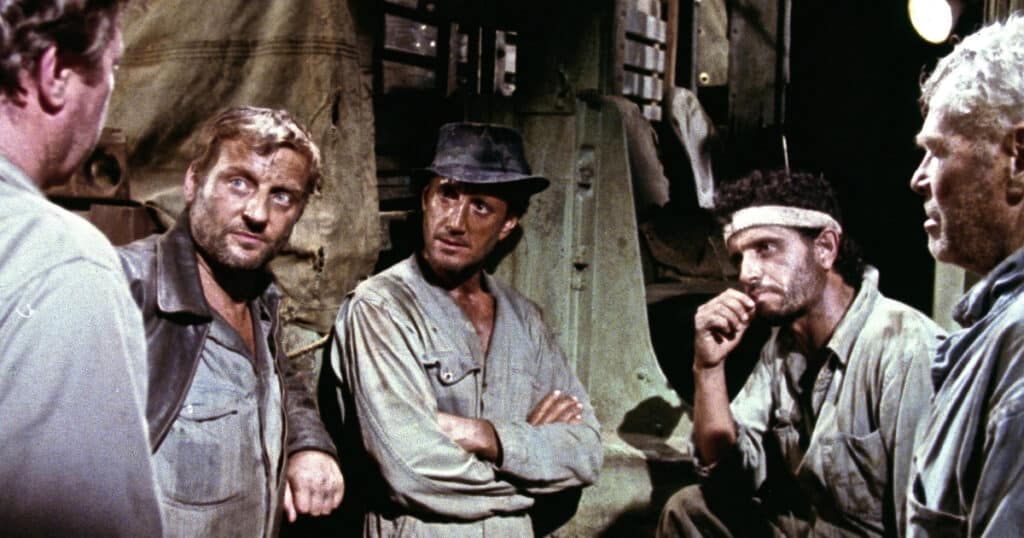
Sorcerer was based on the 1950 novel “The Wages of Fear” by French author George Arnaud, which was subsequently turned into a 1952 movie of the same name by legendary director Henri-Georges Clouzot. Both tell the tale of four desperate men who are tasked with driving trucks filled with unstable explosives through dangerous terrain in order to help stop an oil field fire. One wrong turn, one big bump, the nitroglycerine gets rattled too much, kaboom – everyone’s dead. Friedkin was an admirer of both the book and film, and intended to make a far grittier version than Clouzot, a movie that would be nearly as cynical as he was. Friedkin has always maintained it’s not actually a remake of the movie, but just another adaptation of the book, but he still went to Clouzot to get his blessing for the update, which was granted.
Friedkin initially intended his version to be a reasonably small movie, a side project that he could make cheaply and quickly before embarking on a sci-fi epic called “The Devil’s Triangle,” about the legendary Bermuda Triangle. Safe to say things did not work out that way, and “The Devil’s Triangle” never happened – mostly because Steven Spielberg made Close Encounters of the Third Kind, which allegedly contained many similar concepts.
After spending four months working on his Wages of Fear script with The Wild Bunch writer Walon Green, Friedkin was ready to make the movie he thought would be a major part of his legacy, the big one people would remember him by. Heading to the Dominican Republic, where the weather and conditions would turn out to be wholly unpredictable, Friedkin’s $2.5 million movie eventually expanded to $12 million before finally consuming approximately $22 million – needless to say, a very expensive project in 1976, even more than his peer Steven Spielberg ultimately spent on CloseEncounters. In fact, the budget eventually became so bloated that it took two studios to co-produce it, Universal and Paramount.
Friedkin was interested in making “Wages of Fear” his own in some key ways; the most dramatic change being the four lead characters, depicted as decent men in Clozot’s movie but who Friedkin sought to make highly flawed, morally corrupt individuals – one character literally describes our protagonist as “a real piece of shit”. Transporting the dangerous nitro would be a journey of redemption, even though we see from the film’s first act that they are killers and thieves. Then and now, Friedkin has never been interested in traditional movie heroes. Furthermore, he saw Sorcerer as a metaphor for the world at large, in which strangers who don’t like each other have to find a way to work together; otherwise, everything will explode. A timeless theme, to be sure.
Another key change, obviously, would be the title. Apparently, one working title was “Ballbreaker,” and another was, appropriately, “Dynamite.” But while doing research in South America, Friedkin saw trucks with names crudely painted on the doors. Two such vehicles were called “Sorcerer” and “Lazarus.” Inspired, Friedkin named his two trucks in the movie the same, even if the audience never really gets a clear look at the writing. Friedkin also found a metaphor in the title, saying a “sorcerer in an evil wizard, and in this case, the evil wizard is fate,” further hammering home the idea that these men’s destinies are completely out of their hands.
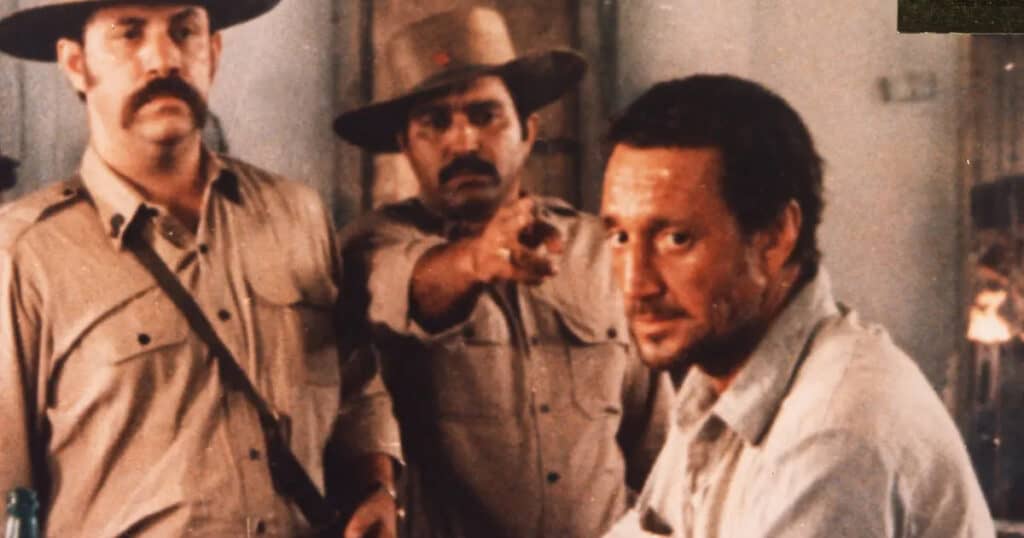
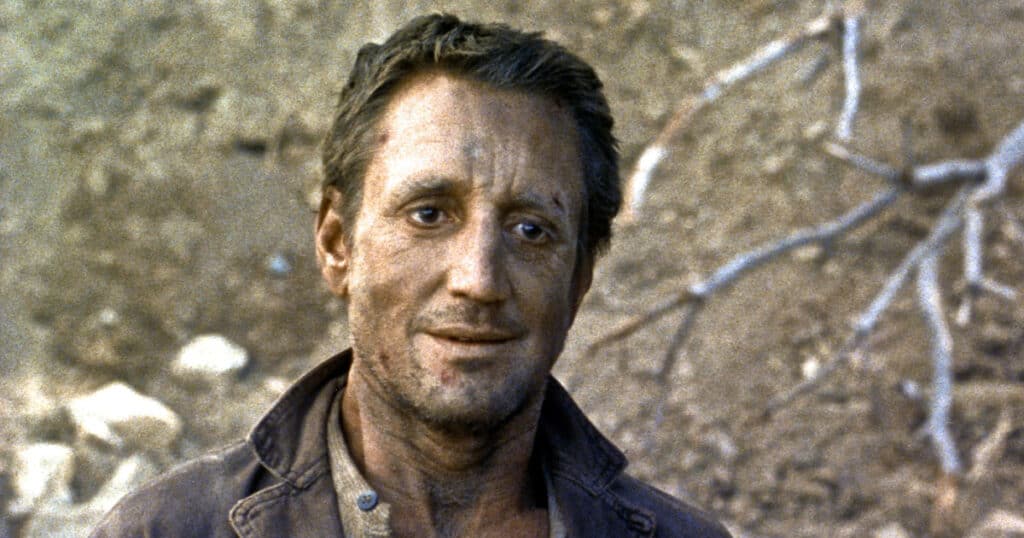
For the lead character of Jackie Scanlon, a crook from New Jersey hiding out in South America, Friedkin envisioned Steve McQueen. McQueen actually loved the script and wanted to do it, but he had just married Ali MacGraw and didn’t want to leave her in the States while he was away for three months shooting the movie. McQueen asked Friedkin if he could write a role for MacGraw so she could accompany him to the Dominican Republic – a request Friedkin scoffed at. After McQueen tried and failed to get her attached as an associate producer, the actor dropped out of the film. Other names like Clint Eastwood, Gene Hackman and Robert Mitchum were tossed around, but ultimately the role went to Roy Schieder, who had previously worked with Friedkin on The French Connection. Their relationship had gone a little frosty because Scheider had wanted to play the role of Father Karras in The Exorcist and was denied. Still, he was coming off Spielberg’s blockbuster Jaws and seemed like a bankable leading man to that film’s studio, Universal.
The other three primary actors were not household names in the U.S., and the studio was concerned the lack of star power would hurt the movie, but Friedkin forged ahead, convinced it wouldn’t matter. He believed people would see the film just because his name was on it. At one point he even told the studio they should change the actors’ names for the release to sound more American, an idea that never got off the ground.
Standing in for the movie’s remote Colombia setting, most of Sorcerer was shot in the jungles of the Dominican Republic, where the crew literally had to make their own roads to film the truck-driving scenes. It was beyond hot and uncomfortable, and throughout the production many people – Friedkin included – fell ill with malaria or dysentery. Some crew members were sent back to America because they were suspected drug users, which the local governments would not tolerate, so to avoid winding up in prison, they simply fled back to the states and had to be replaced.
And if the crew wasn’t sick or evading jail time, they were being canned. Already known for a volatile personality that earned him the nickname “Hurricane Billy”, Friedkin was in full dictator mode out in the jungle, routinely firing people left and right, including production managers, teamsters, stunt people and anyone else who rubbed him the wrong way, even his own longtime line producer. His first cinematographer, Dick Bush, was replaced during production because Friedkin was not pleased with his work. He even got into it with Roy Scheider, even though they got along well during French Connection. Scheider would later joke he was the only person Friedkin could not fire because he was the leading man, and said the famously-troubled Jaws production was a picnic compared to Sorcerer.
Considerable challenges came when shooting the film’s most incredible sequences, where the nitro-carrying trucks have to cross a rickety rope bridge over a raging river. The initial river chosen in the Dominican Republic was nixed because it was bone dry due to a drought in the country. The production decided to move to Mexico, where they found a river that looked appropriately intimidating. However, after the bridge was constructed, the water began to dry up, and the river became no more than a trickle. Perhaps the production was cursed? To compensate, Friedkin had to fake the river by pumping thousands of gallons of water into it, while also utilizing rain machines and hoses to create the powerful storm. The shaking and swaying of the bridge was achieved by placing hydraulic mechanisms underneath to simulate its flimsy nature, and oftentimes the trucks themselves were attached to the bridge in order to keep them from slipping off. Even so, they did fall into the river, many times, once while Friedkin was inside the cab. The actors were often actually driving the trucks, or at least steering them, and somehow none of them were ever seriously hurt. The two bridge sequences together, lasting about 12 minutes in the film, took several months to complete and chewed up around $3 million of the movie’s growing cost.
Another of the movie’s key moments is when the trucks arrive at a gigantic fallen tree that’s blocking their route; the only solution to use some of the nitro and blast the thing to smithereens. The production hit a snag when it turned out they didn’t have nearly enough explosives on hand to actually put a sizable dent in the tree, so Friedkin called a disreputable associate of his from New York to help. “Marvin the Torch” was an arsonist who blew up buildings for people looking to collect the insurance money, and although he was supposedly retired from this questionable line of work, he still flew to the Dominican Republic armed with a couple of suitcases filled with quote-unquote “beauty supplies.” At the end of the day, Marvin detonated the tree, the explosion was spectacular, and “the Torch” was back on a plane a day or so later.
After filming on the movie was complete – a shoot that lasted somewhere in the crazy neighborhood of ten months – editing began, which at least according to Friedkin went fairly smoothly. But the studios were nervous, unsure if they had just tossed over $20 million into a flaming oil well. After some execs from Universal saw an early cut, they summoned Friedkin to a meeting to discuss. Friedkin brought writer Walon Green and his editor Bud Smith to the meeting, instructing them to just stare blankly at the suits as they read over their notes, but not to nod or agree with anything they said. Friedkin himself ordered a bottle of vodka and began drinking straight from the bottle during the meeting, eventually falling on the floor. The aim was to disorient the executives so much that they would just leave them alone, which is pretty much exactly what happened. Friedkin had final cut on Sorcerer, and was intent on crafting the masterpiece he had pictured from the start.
To score the film, Friedkin hired German electronic group Tangerine Dream, who he’d seen play a concert in Germany years earlier. Friedkin was mesmerized by their music and asked if they’d be interested in scoring his next movie. He eventually sent them the script for Sorcerer and wanted them to write the score based only on the pages; in fact, they finished the score and sent him the tapes while he was still shooting the film. In an unusual creative decision, Friedkin and his editor eventually cut the movie to match the eerie and surreal score.
Sorcerer was released in theaters in June 1977; the studios stood by the movie and rolled it out with fanfare. But almost immediately it was clear that Friedkin’s big gamble would not pay off. The reviews were tough, and the box office was even tougher. This was the summer of Star Wars, released just a month earlier and well on its way to becoming cultural phenomenon. Audiences wanted to bask in the brilliant space fantasy world created by George Lucas, not sit in a truck filled with nitroglycerine with guys who hardly spoke. As moviegoers kept returning to see the galactic heroes defeat the oppressive Empire, Friedkin’s band of sweaty criminals was essentially ignored.
Some theorized that the title could have been an issue: a movie called Sorcerer from the director of The Exorcist implied a supernatural picture, but when it became clear that wasn’t the case, audiences were turned off. And aside from Scheider, a complete lack of familiar faces in the cast didn’t help. Whatever the reason, Sorcerer’s time in theaters was even rougher than the roads traveled in the movie — it couldn’t even compete with Exorcist II: The Heretic, director John Boorman’s dodgy sequel to Friedkin’s own massive hit. Ultimately Sorcerer only grossed about $9 million that summer and was quickly chased from theaters that wanted more screens for Star Wars, which ironically cost around half of Sorcerer’s budget. Money Into Light has an interesting piece about how the movie was brutally cut down in the international version, with it also being renamed The Wages of Fear.
The box office disaster also chased away Friedkin; the director exiled himself to France to lick his wounds while pondering what went wrong. After living and acting like a God for a few years, he came crashing back down to Earth, correctly guessing there were plenty of people glad to see him taken down a few notches. And while he’s reached some high notes since, with movies like To Live and Die in L.A., and Killer Joe, Friedkin’s career seemed to take a nitro-blast in the guts after the experience of Sorcerer.
Of course, in the years after its theatrical failure, Sorcerer has undergone something of a reevaluation, as time has been very kind to it. Now, many movie fans appreciate the suspenseful, unnerving, masterfully-produced thriller that it is. Friedkin says it’s still the movie he’s most proud of, and it was certainly the most difficult to make. People like Stephen King and Quentin Tarantino rank it among the greatest movies ever made, and it’s being rediscovered all the time. When put together with The French Connection and The Exorcist, Sorcerer completes a three-movie streak from a man at the very top of his game. Fittingly, the making of Sorcerer was nearly as torturous and harrowing as the events it depicts, and maybe even more fittingly, it was not appreciated for how impressively it accomplished its job. But after a very grueling start, it’s now recognized for being a true gem; perhaps that was its destiny all along.
BOSTON, May 15, 2023 (Newswire.com)
-
Frederica M. Williams, president and CEO of Whittier Street Health Center, a community health center with a mission to serve as a center of excellence that provides high-quality and accessible health care and social services that achieve health equity, social justice, and the economic well-being of a diverse patient population, was among 200 Black women honored during a May 12 special event at the Massachusetts State House hosted by Amaka Ubaka of Channel 7 News.
The 200 honorees represent all Black women who have worked tirelessly to make the greater Boston area a better place since the 1700s. The list was determined by members of the Black Women Lead Honorary Committee who researched the lives of Black Women leaders from the greater Boston area from the 18th century through the present.
In addition to Williams, the distinguished list includes Joyce London Alexander, the first African American to be appointed Chief Magistrate judge in the United States, and Chloe Spear, an African-born woman who authored "Lady of Boston" and lived both as a slave and free woman in Boston.
"To be included in such an illustrious list is a true honor," said Williams. "The contributions that these Black women leaders have made over the centuries are immeasurable and a testament to their intelligence, talent, determination, and strength of mind and character.
"This award represents all the Black women on whose shoulders I rest - my family, colleagues and patients at Whittier," Williams continued.
The event was presented by Boston City Councilor Brian Worrell, State Representative Christopher Worrell, and Ed Gaskin, executive director of the Greater Grove Hall Main Streets, with support from The Kraft Foundation.
The Black Women Lead Honorary Committee members include Senator Elizabeth Warren, Attorney General Andrea Campbell, State Representative Brandy Fluker-Oakley, Congresswomen Katherine Clark and Ayanna Pressley, Boston Mayor Michelle Wu, and Massachusetts State Auditor Diana DiZoglio.
About Whittier Street Health Center
Whittier Street Health Center is an independently licensed community health care center with a mission of providing high-quality, reliable and accessible primary healthcare for diverse populations while promoting wellness and eliminating health and social disparities. A champion of equitable access to high-quality, patient-focused care, social justice and economic equity, Whittier Street Health Center serves more than 30,000 patients and 20,000 community outreach visits annually; its ethnically and racially diverse patient base is primarily made up of individuals from Roxbury, Dorchester, Jamaica Plain, the South End and greater Boston. Approximately 28% of Whittier's patients are uninsured. Whittier Street Health Center provides a comprehensive array of 40 healthcare programs and services designed to meet the primary health care, behavioral health, and social needs of the community. For more information, please visit www.wshc.org as well as Facebook (www.facebook.com/WhittierStreetHealthCenter), Twitter (@Whittier_Boston), or LinkedIn (https://www.linkedin.com/company/whittier-street-health-center), or call 617-989-3221.